Tax Reforms and Multi-Dimensional Screening
Abstract
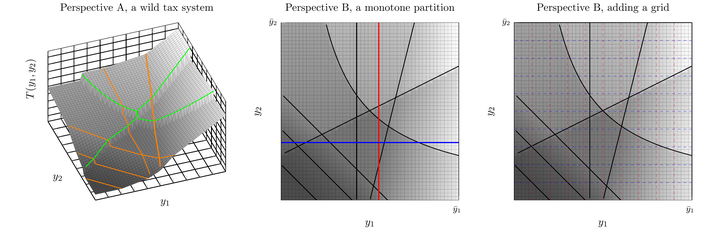
The key question in multi-dimensional screening problems is how prices, incentives, or marginal tax rates in one economic activity should vary with other activities. We develop a theory of tax reforms in a setting with multi-dimensional heterogeneity amongst agents who take two economic decisions. Our leading application is the taxation of couples who choose an earnings level for each spouse. In our theoretical analysis, we characterize the conditions under which reforms of a given tax system yield Pareto- or welfare-improvements. In an empirical application to the US, we quantify the welfare implications of such reforms. We also prove an impossibility result: under assumptions common in the tax perturbation literature, the hypothesis that the given status quo tax is optimal leads to a contradiction. Thus, the perturbation approach cannot be used to characterize a fully optimal tax system.